

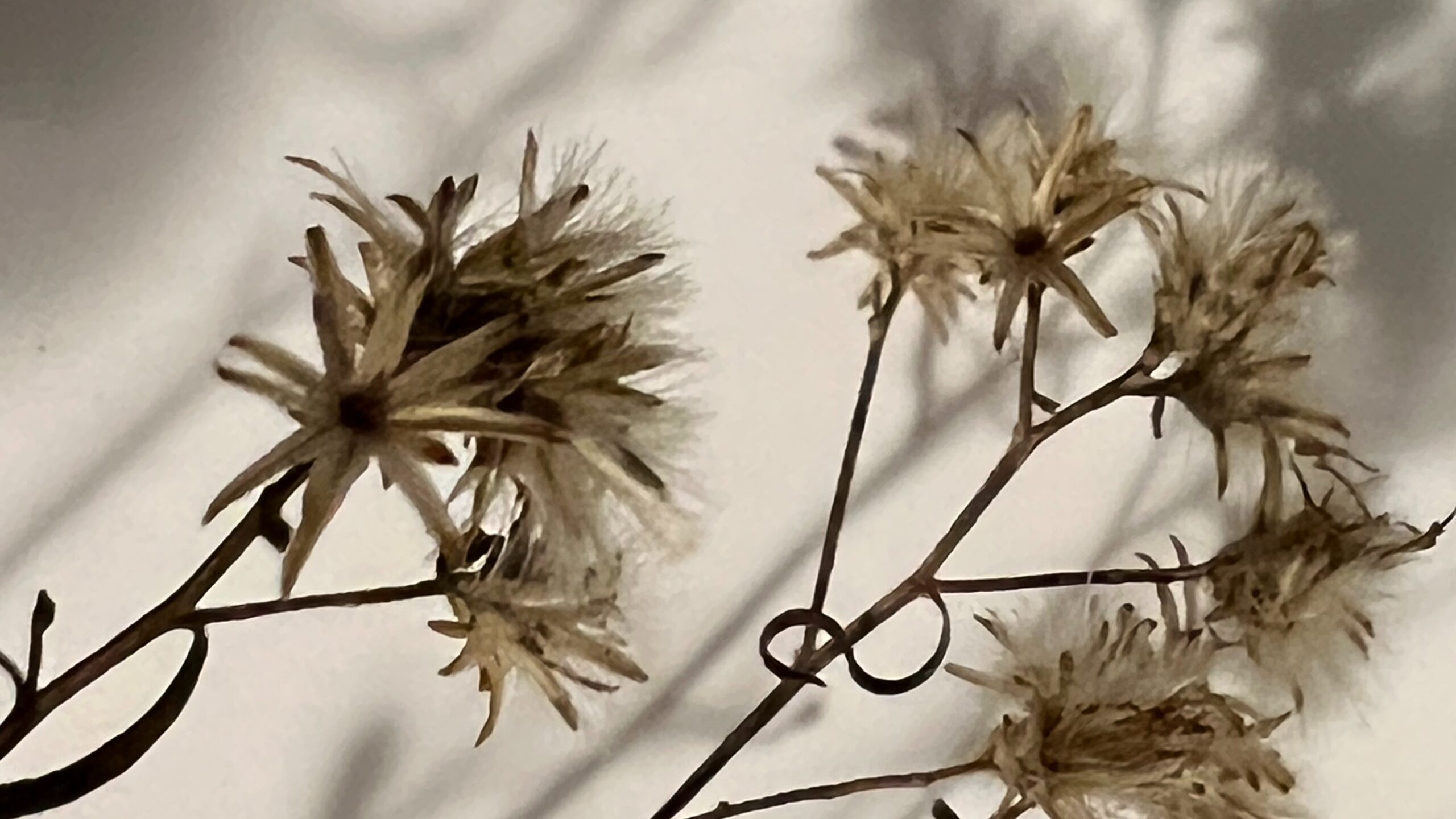
Yesterday was a groundwork day in my 100-pattern project—one focused on observation, translation, and decision-making rather than producing a finished pattern.
The Walk and the Artifact
I returned to Graham Creek Nature Preserve and walked along the trail near the marsh. I took photographs as I went, but what ultimately held my attention was a cluster of dried wildflowers growing at the edge of the path, with new green growth just beginning to emerge beneath them.
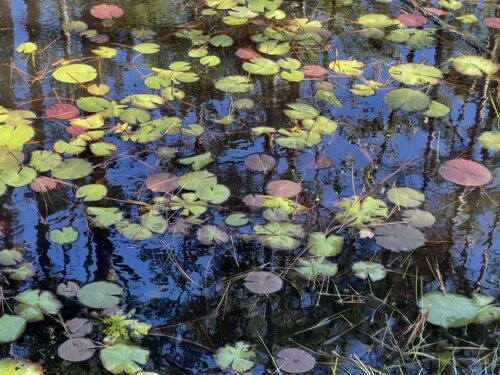
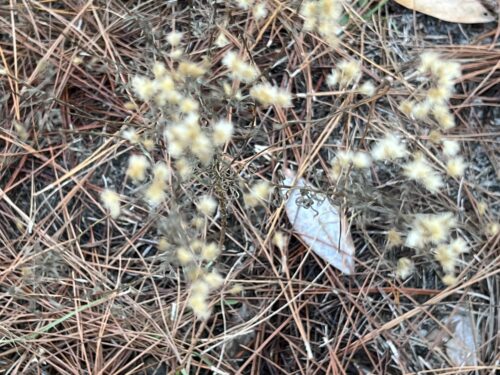
The plants were the remains of last year’s asters. The stems were thin and brittle and snapped easily. The flower heads sat at the very tips of the branches, gathered in small clumps, while lower down the leaves had dried into tight curls. The heads themselves were soft and puffy, like small clouds held on branching sticks. These dried aster stems became the artifact of the day.
Photographing the Artifact
Back in the studio, I photographed the asters on a white background. I worked with small clumps and individual stems, mostly laying them flat, with a few propped up to minimize shadow. The goal was clarity rather than polish—to isolate the forms and understand their structure without the distraction of the surrounding landscape.
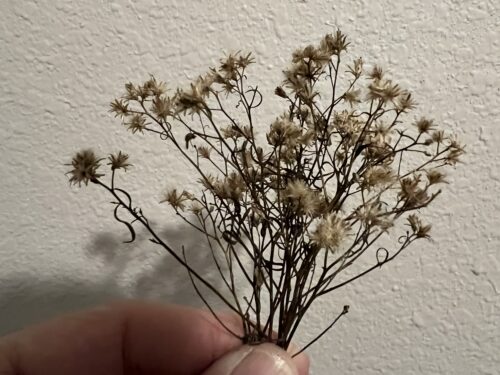
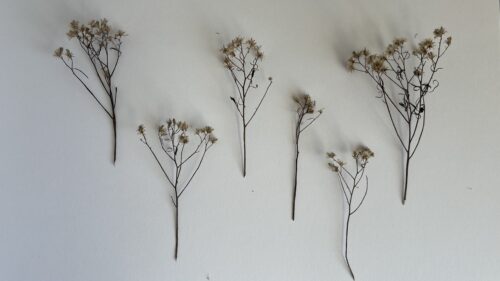
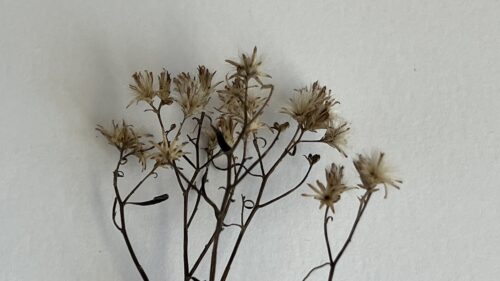
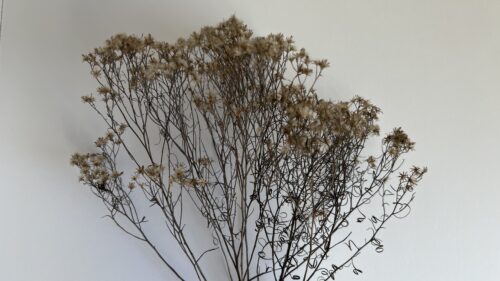
Seen this way, certain qualities became more pronounced: the irregular branching, the concentration of visual weight at the tips, the negative space between stems, and the contrast between soft flower heads and wiry supports.
Drawing and Translation
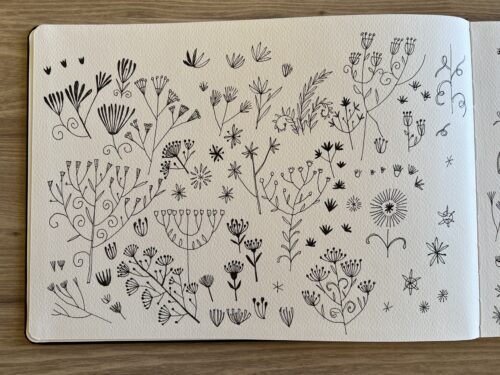
I moved next into drawing, beginning with observational sketches to understand the asters as they appeared. From there, I started to stylize, testing different ways these forms might translate into marks that could eventually function as pattern motifs.
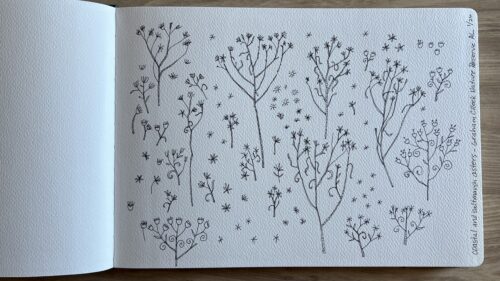
I explored simplified starbursts, radiating lines, cup-like forms, and loose spirals derived from the dried leaves. As the page filled, some drawings stayed close to the original structure, while others drifted into more generic floral territory. At this stage, the work was intentionally exploratory—focused on discovering a visual language rather than locking in solutions.
Thinking Toward Pattern Structure
As the drawings accumulated, my attention shifted from individual marks to how they might behave in repetition. I began sketching rough layouts and thinking about pattern structure rather than motif refinement.
An idea emerged around an invisible scalloped grid holding small bouquet groupings. Instead of relying on a single repeated motif, I started considering a set of three to five related but distinct bouquets—similar in scale and rhythm, but varied enough to keep the surface from feeling rigid. These layouts remain provisional, serving as a framework rather than a finished plan.
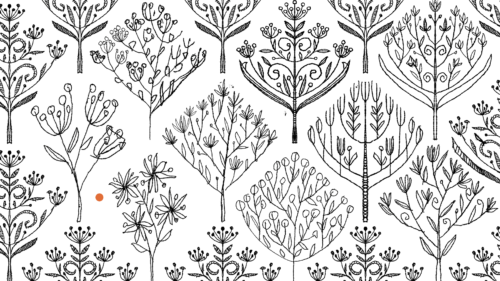
Sketching through balance and looseness. | Some of these bouquets lean into symmetry, while others intentionally tip it off-center. The smaller, simpler forms near the dot feel promising—gentler, more playful, and closer to where this pattern wants to go.
Concerns and Open Questions
This stage of the process raised a set of questions I want to keep visible.
Translating a small, delicate dried flower has proven more challenging than I initially expected. The asters’ appeal lies in their fragility and restraint—their skeletal structure and lightness. Finding marks that communicate that delicacy without becoming fussy or losing clarity is difficult.
There is also tension between observation and stylization. While the asters can be drawn accurately, simplification quickly leads toward generic flower forms. Those forms may function well in wallpaper, but risk losing the specificity that made the artifact compelling to begin with.
I am still undecided about how closely the final work should remain tied to the aster form. It may stay directly influenced by it, move further into abstraction, or eventually let the reference fall away entirely. For now, that question remains open and documented.
Placing This Day in the Project
No finished pattern came out of this day, but it holds an important place in the larger project. This is the kind of work that shapes future designs quietly—through testing, editing, and learning where forms begin to lose their meaning. These decisions, questions, and partial drawings become part of the foundation that later patterns are built on.
Studio Notes
Project: 100 Patterns
Location: Graham Creek Nature Preserve, Alabama
Artifact: Dried marsh aster stems
Focus: Observation, stylization, early pattern structure
Status: Groundwork day (no finished pattern)