

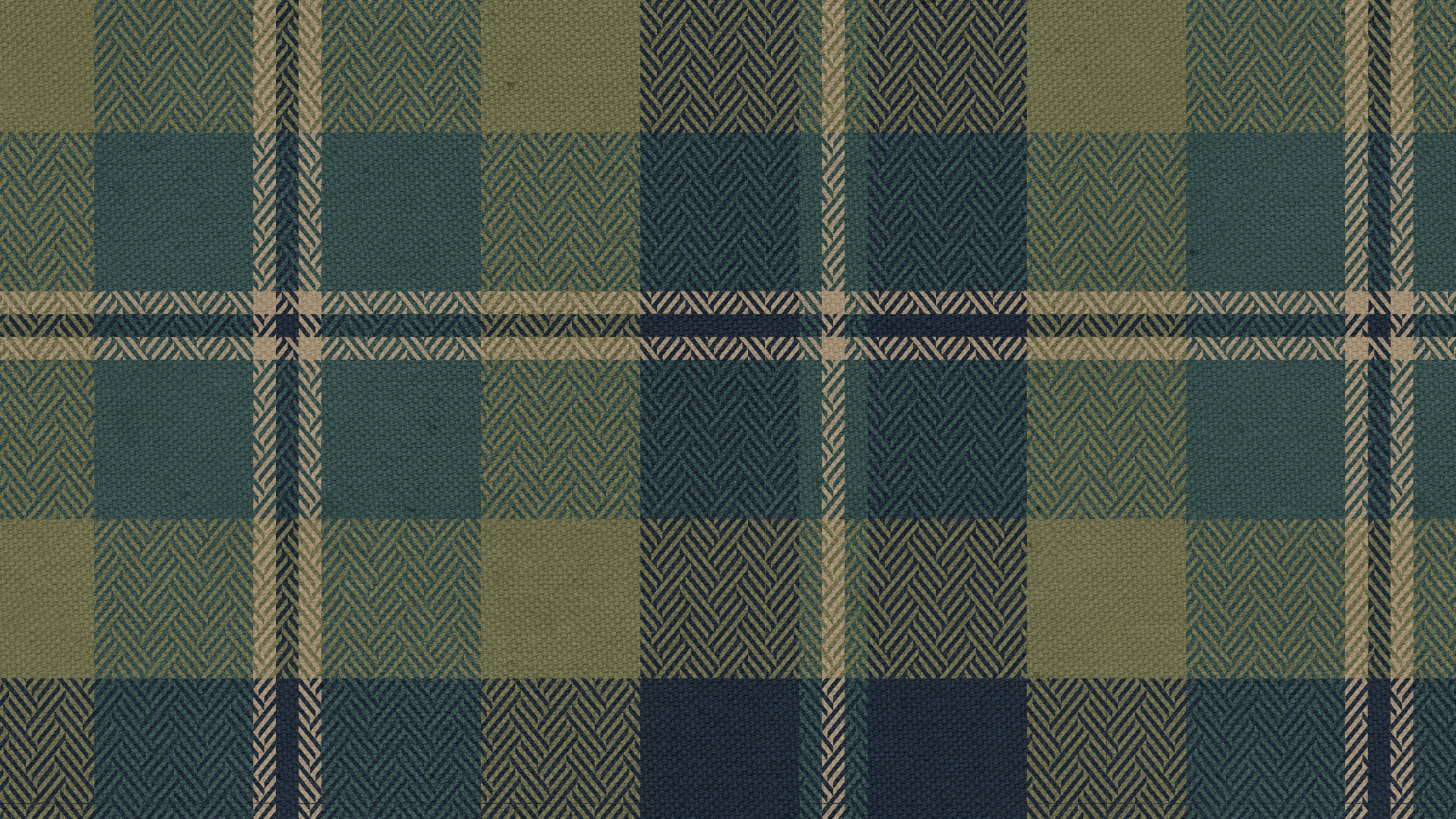
This post documents a short design study exploring how different internal weave structures behave inside a single plaid layout, particularly when used as wallpaper and viewed at architectural scale.
The starting question was simple:
If the plaid itself stays constant, how much can the surface character change by altering only the internal structure?
To test this, I designed one contemporary plaid and repeated it multiple times at the same scale and colorway. The plaid layout does not change. Only the internal weave or weave-like structure inside each block does.
Plaid is often treated as a finished look — a familiar arrangement of stripes that implies a particular fabric, era, or mood. In interior spaces, especially when used as wallpaper, plaid is usually chosen for its reliability. It reads clearly at scale, anchors a room, and brings structure without overwhelming it.
This project approaches plaid differently.
Rather than treating plaid as a fixed outcome, I treat it as a framework: a stable surface structure that can hold variation inside it. In this study, a single contemporary plaid layout is repeated multiple times, unchanged in scale, proportion, or color. What changes is the internal structure — the weave or weave-like pattern filling each block.
From across the room, each version reads as the same plaid.
Up close, each reveals a different surface character.
Distance First, Detail Second
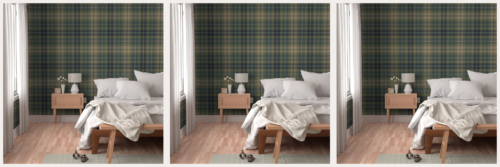
Multiple versions of the same plaid shown at room scale. The layout, scale, and colorway are identical.
Looking at the wall mockups, the differences between versions are intentionally minimal. From across the room, these plaids are difficult to distinguish. This consistency is not a flaw—it reflects how wallpaper is actually experienced in a space. The first read is always structural and atmospheric.
The differences appear only when you move closer.
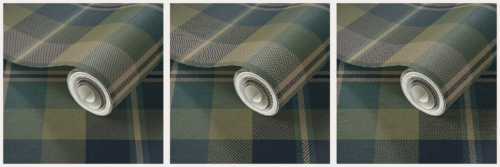
Close-up views reveal changes in internal structure that are not legible at room distance.
This distinction between distance and proximity became one of the most useful outcomes of the study. Subtle internal variation can add interest and texture, but it does not announce itself in a marketplace environment where designs are scanned quickly and judged at thumbnail scale.
Traditional Textile Structures
These examples use loom-based textile logic and are familiar within the context of classic plaids.
Basic Twill (Continuous Twill)
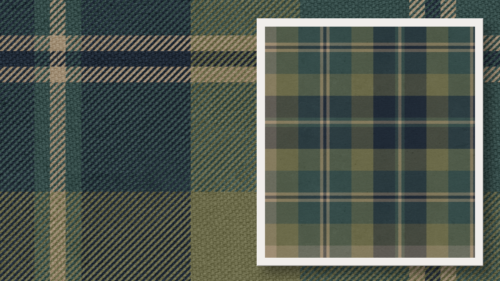
A continuous diagonal twill provides a familiar foundation. It reads clearly as fabric and establishes a baseline for comparison with more complex structures.
Classic Herringbone (Broken Twill)
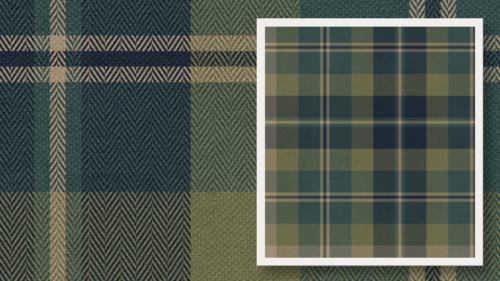
Herringbone introduces directional rhythm through regular twill reversals. It is immediately recognizable and carries strong associations with heritage textiles.
Chevron (Broken Twill)
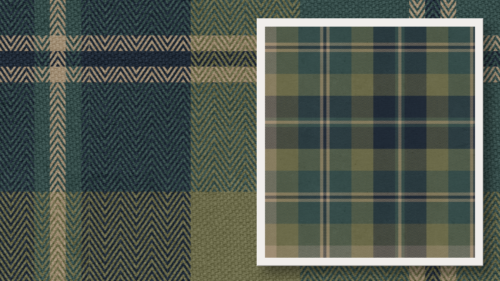
Chevron uses mirrored twill reversals to create a sharper, more graphic surface. While closely related to herringbone, it produces a distinctly different visual rhythm up close.
Elongated Herringbone (Extended Broken Twill)
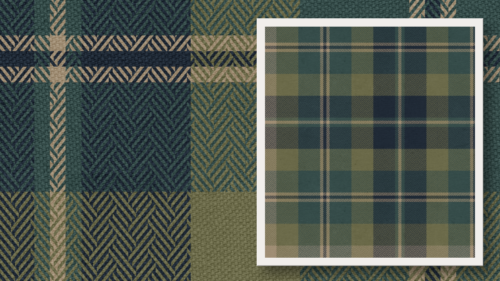
By lengthening the diagonal runs before each reversal, the herringbone becomes calmer and more architectural. This version highlights how small parameter shifts can subtly change surface character.
Houndstooth (Broken Twill Pattern)
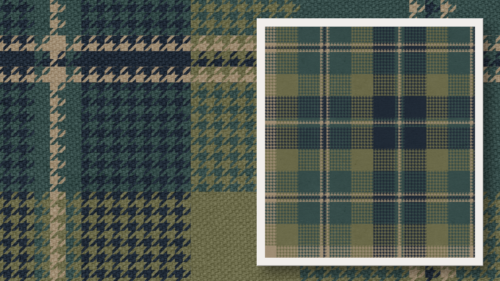
Houndstooth transforms broken twill into a bold, iconic motif. It represents the upper end of visual complexity while still functioning within the same plaid framework.
Structural and Ornamental Variations
These examples move away from strict textile construction and toward surface pattern, while still behaving like weave at scale.
Chain / Interlocking Structure
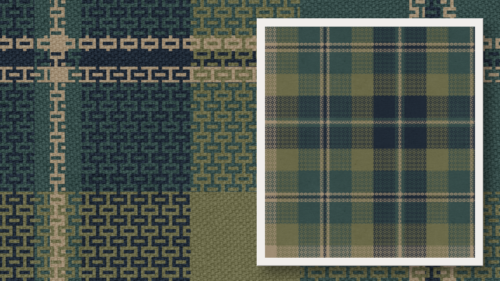
This linked pattern suggests interlacing rather than over–under thread logic. From a distance it compresses into texture; up close it reads as more graphic and ornamental.
Prince of Wales (Glen Check)
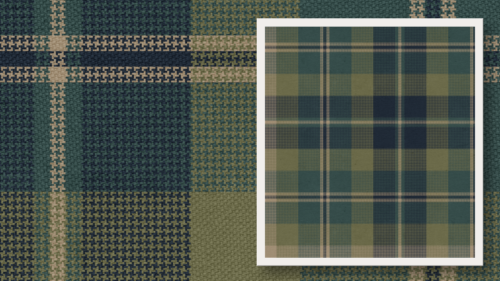
Prince of Wales is not a weave, but a plaid structure composed of herringbone blocks. It combines multiple layers of structure and scale, demonstrating how complex heritage patterns can still be controlled within a single system.
Greek Key / Meander Pattern
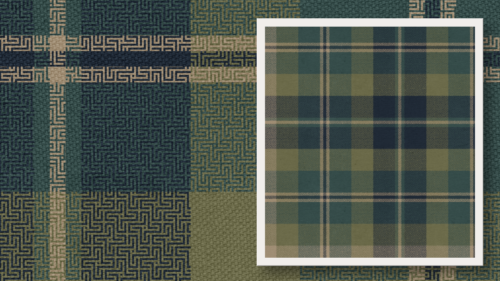
Rooted in architectural ornament, this pattern replaces textile logic with continuous right-angle turns. Within the plaid, it behaves as texture at a distance and ornament up close.
Stepped Chevron (Ornamental Zigzag)
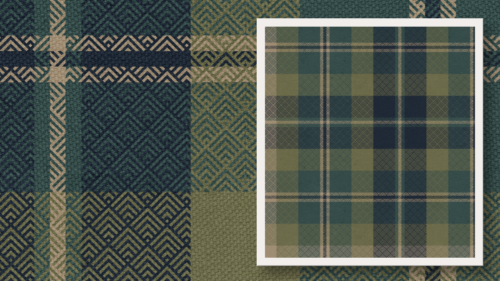
This geometric zigzag is constructed rather than woven. It represents the furthest extension of the system, testing how far the plaid framework can stretch beyond cloth.
What This Experiment Clarified
This study confirmed that a single plaid layout can support a wide range of internal structures without changing its overall read in a space. It also clarified a limitation: subtle internal variation is not always surfaced well in a marketplace environment, even when it becomes meaningful in physical application.
That distinction is useful. It helps separate what works as a standalone product from what works best as a custom or conversational design approach.
This post documents the test, the results, and the limits of the system as it exists today. It will inform how I approach plaid, surface texture, and print-on-demand moving forward.